SUPPORTING PEOPLE WITH 
|
|
|
|
Hi ya party people,
WE SURVIVED ANOTHER WEEK!!!!
I hope this week was kind to you (it wasn't to me). If you had a not-so-fun week, I hope you at least had a good snack and a relaxing weekend planned.
A good snack is legitimately one of the little things I have to look forward to some days. 😅 Shout out to sour watermelon Mike and Ikes for getting me through this week!
Our Q&A this week is not so sweet, but we’re not strangers to drama.
We've got someone who ran into issues at a SHRM event, which isn’t even a shocker at this point. 😒
And then we've got an HR team at a thousand-person company trying to explain to employees that no, you cannot just "contact HR" like it's a monolith, because there are coordinators and generalists and HRBPs and directors and everyone has a lane, and guess what, we're going to need you to use it.
Let's discuss, and if you have questions of your own to submit, submit them here!
✨ And don't forget to get your application in for the Safe Space Summit! IDK if you saw the annoucement this week but Oct 13th - Oct 16th we're taking overrrr Huntington Beach. Sun, fun chats, activities and your favorite people in one place.
|
|
|
|
✨ Don't forget: You can always vent, celebrate a win, or find support in Safe Space
|
|
|
|
SPONSORED BY ESKILL
Think you know HR better than me? 😁
eSkill built a custom test just for IHIH readers, and you have a chance to prove it!
(All in good fun, of course.)
It's a peek behind the curtain at what your candidates actually experience, plus a chance to prove how much HR wisdom you're sitting on.
So channel your competitive spirit and take the test real quick. Come for my #1 spot if you think you're ready!
|
|
|
|
☕ frustration & communication |
|
|
|
✍🏾 How do you communicate to employees the division of functions in HR operations? We're adding a new role and would like to take this opportunity to layout for employees when to contact whom such as coordinator v. generalist v. HRBP v. director.
Context: ~1000 employees, A/E/C industry, employee-owned.
|
|
|
|
📣 Lia Seth, Director of People @ Cylinder Health:
If you have an intranet, this is a great place to store this information, as well as a way to introduce and humanize your team! Each member can share their photo, location, a fun fact ("I've fostered over 20 cats" "I've lived on three different continents" "I never learned how to ride a bike") and their specialty.
My favorite way to structure this is to think about it from the employee side. Rather than saying "I focus on employee relations," remember that not everyone knows what that means, and instead say something like "Ask me about interpersonal concerns, feedback about your manager, and performance reviews!" The more you speak their language when explaining your function, the better they'll understand how to work with you.
📣 Cassandra Schaffa, Sr. Director of People @ Mixlab, Inc.:
I have always found this to be a challenge no matter the size of the organization or HR team. You can communicate it a million times in a million different ways, but it will go in one ear and out the other. I believe the best option is to have a centralized inbox that is monitored by your coordinator and they forward inquiries to the correct team member. If you have budget for a ticketing system, even better since ticketed inquiries can be automatically routed to the correct individual to respond. Additionally you can create a one-pager HR directory with a picture of your team members, titles, and define who employees should go to for certain inquiries.
Share this with new hires, auto send it to the whole company every few months as a reminder, post it somewhere in the office, and have it saved electronically somewhere employees can access. If you're using Teams/Slack, add an "Ask me about..." line in each HR person's profile, could also add that to their email signature. Lastly, kindly redirect employees when they reach out to the wrong person and hope they'll get it right next time. I'll typically say, "Thanks for reaching out, Jane actually handles benefits questions. I'll have her reach out to you."
📣 Luke Willman, Engagement & Culture @ St. Elizabeth Healthcare & St. Elizabeth Physicians:
I have a different take on this... we intentionally use a No Wrong Door Policy.
In a service-oriented culture, the burden of navigation should sit with HR, not the employee. If someone reaches out to the "wrong" person, it’s not an interruption - it’s a trust-building opportunity. It shouldn’t matter who they go to - it matters that they felt comfortable coming to someone. Redirecting an employee is as simple as saying, "I’m not the expert on that specific policy, but let me introduce you to [Name] who is. I'll stay on the thread to make sure you're taken care of." When you treat the "wrong" contact as a handoff rather than a hurdle, you solidify the relationship instead of damaging it.
It's a losing battle to try and force your entire workforce to memorize your internal org chart just to get an answer about their INSERT INQUIRY HERE... logistically and culturally;)
Safe Space members can join this discussion here. Not a member yet? Apply to join here.
|
|
|
|
✍🏾 Why are HR people so close-minded?
Context: Spoke at a SHRM conference about who's coming into the workplace. Used some PEW data and got blasted as "Political, I had to walk out." No, you CHOSE to walk out. I'm done with SHRM speaking.
|
|
|
|
📣 Safe Space Member:
It would actually help to know what you presented and what data you used.
That said, when I hear “too political” in HR spaces, I don’t automatically think people are close-minded.
I think people have a hard time separating allyship in general from what is actually appropriate, or even allowed, within the workplace. Those are two very different things, but they get blended together constantly. Because people’s identities are often tied closely to what they believe and who they align with. So even if something is meant to be neutral or data-driven, it doesn’t necessarily get heard that way, but rather it gets filtered through a personal lens.
And once that happens, it gets labeled “political,” regardless of intent.
In HR, sometimes "political" means, “this doesn’t align with my beliefs,” and sometimes it just means, “I can see where this is going and I don’t want to deal with the fallout.”
Either way, I don’t think it’s always about being close-minded. I think it’s more about how hard it is for people to separate what they believe from what the workplace is actually structured and legally allowed to do.
📣 Sondra Norris, Founder @ Strategic Culture Partners:
Hmmmmm ... tricky question.
One lesson I see here is a common theme in my HR experience: We often want everyone on board with whatever it is we're peddling (because we really do know it would be awesome and solve a lot of problems). But we haven't gotten great at translating it out of HR-speak and into business-speak. I had to use the sneak attack many times, and I still do. I eventually never billed it as "Build Trust" or "Leadership Development" and started billing it as "Bring Your Product to Market" or "Retain Your Top SDRs." And then it was all about building trust and leadership development.
Another lesson I see here is another common theme in my HR experience: reacting to one data point. I saw this over and over whether it was about how performance management should be handled, which HRIS system to go with, etc. Two things about that: (1) HR is a PROFESSION and then a service. Not every human can do this just because they're ... human and have managed to live 35 years on the planet. (2) If you react to every data point without running it through your accumulated knowledge and experience ... you'll be viewed as wishy-washy or as playing favorites.
The third lesson I see here is an individual one. You're absolutely right when you say they chose to walk out. That's theirs to own. And who knows why your particular data pushed a particular button with them that day? Lawd knows there's more than enough reason to be activated by anything that faintly smells political these days. Maybe their underwear was too tight. Maybe they were just searching for a reason to gracefully get out of the room and you were the fall guy. The problem is that you assigned some sweeping brutal meaning to one person's actions. I'm sure reading that feedback sucked - it wasn't your intention at all, you were there to help.
📣 Jessica M., HR Generalist @ AOC N.A.:
I think often the presentation of HOW we say things is just as important - if not more important - than WHAT we're actually say. Knowing your audience is so critical in knowing how to communicate best with that group and get your point across.
For example, asking "why are HR people so closed minded" in an HR group doesn't seem to have gone over well... I would encourage taking the emotion out of it, even though it's hard and you're proud of the work you put into your presentation. But if you want valuable feedback and you truly want to dig into the "why" behind that interaction, I'd recommend sharing facts about the presentation at the time an individual made the political comment and ask for feedback on the situation. "Do you think this came across politically?" "This was the point I was trying to make.. do you think I could have taken a different approach?" Maybe it was just that person, maybe the delivery could have been improved?
HR is often one of the least close-minded in corporate structure. We constantly think outside of the box for solutions, champion new ideas, hear people out, and look for ways to improve our roles and company cultures.
Safe Space members can join this discussion here. Not a member yet? Apply to join here.
|
|
|
|
SPONSORED BY SALARY.COM
Over 52% of comp professionals admit their job architecture is outdated. 👀
That means most of us built a pay structure, then put it in a drawer and called it a day.
That's exactly where pay inequities come to live rent-free!
Salary.com has a free guide that will show you how to build a skills-based job architecture that stands the test of time, with concrete steps for mapping skills to levels and pay bands that eliminate the vibes-based comp decisions we've all witnessed.
Whether you're fixing a broken framework or starting fresh, fair pay stops being a talking point and starts being a system.
|
|
|
|
🎧 You know when something’s clearly wrong at work, and you realize the system isn’t built for you to fix it? I sat down with Keisha Toussaint to talk about choosing courage anyway, and what happens when leadership doesn’t like it. Check it out on Spotify or Apple Podcasts!
❤️ NYC SPRING FLING: We're doing a Safe Space meet up in NYC in May! It's time to celebrate and have some fun with your favorite HR community.
📣 The Safe Space Summit is BACK! Mark your calendars for Oct 13th - 16th, Huntington Beach here we comeeee. Apply for a spot!
📊 1,000+ HR leaders just told us exactly what's keeping them up at night. Lattice's 2026 State of People Strategy Report breaks down the biggest priorities this year like AI, DEIB, performance management, and more, so you can stop guessing and start planning.*
*This one is brought to you by one of my amazing brand partners
|
|
|
|
Each week I feature a resource I love from the Safe Space library that I believe would be relatable to this week's newsletter topic.
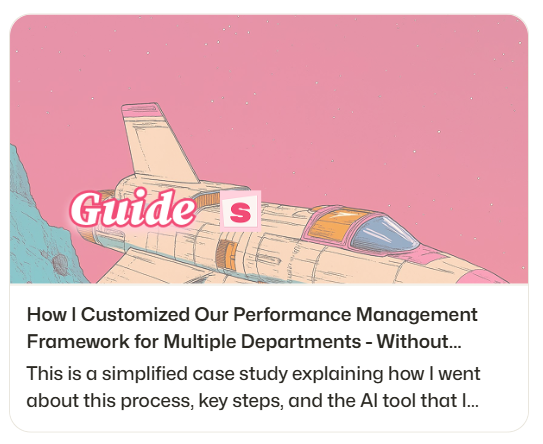
This week, we have a performance management framework for multiple departments, without overloading a 2-Person HR team. Check it out HERE ⬇️
|
|
|
|
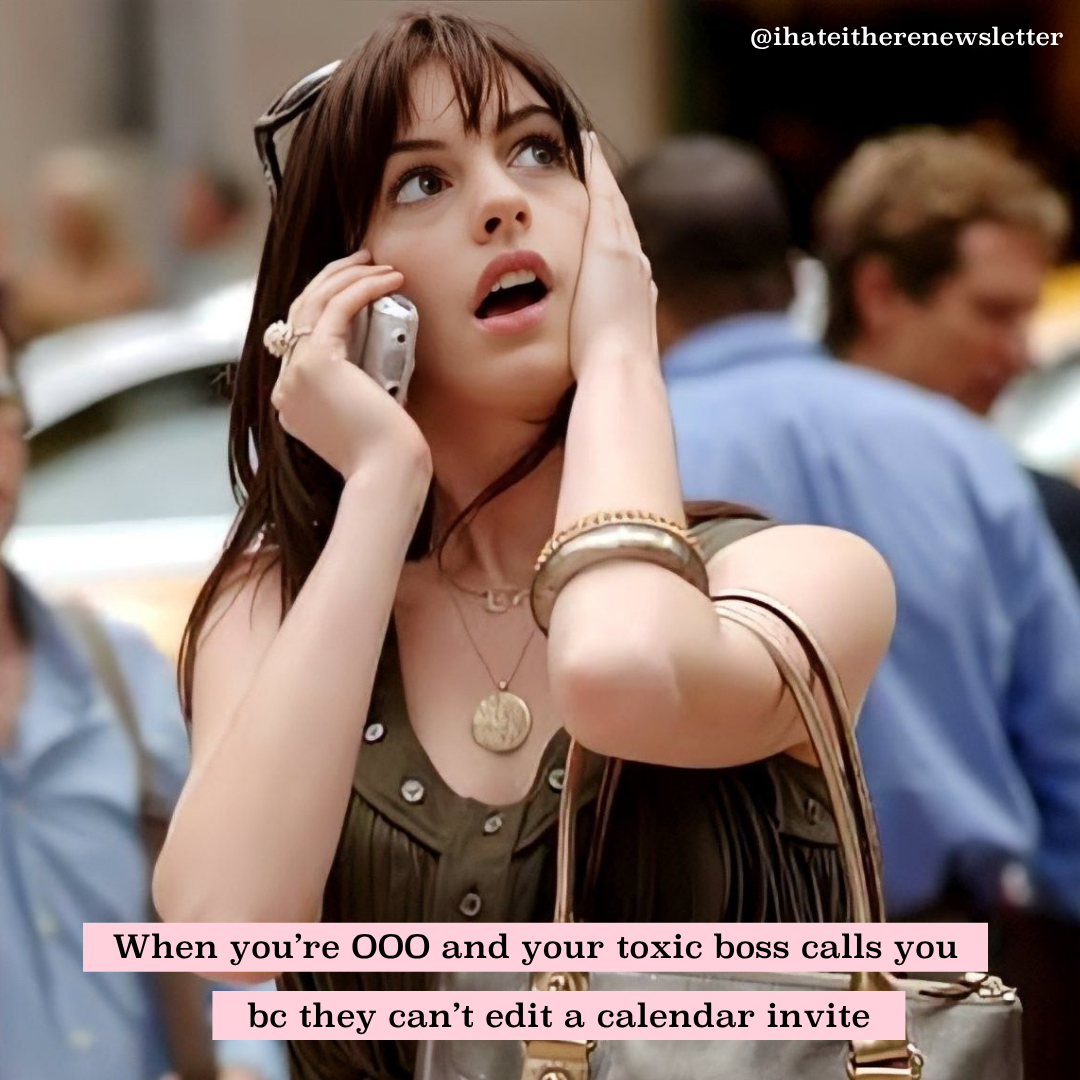
😂 is this an emergency??? no, then GOODBYE |
Okay hot take: should all calls from work people be blocked whilst on PTO??
MAYBE!!!
What do you think??
(Clearly I'm kidding because there might be an ACTUAL emergency - what's not an emergency is a calendar invite, sorry!!!)
|
|
|
|
That's all for this week! I hope you enjoyed! If you have any thoughts, please let me know. I'm allll ears.
Reminder: Today is FRIDAY. 🙏
|
|
|
|
Join 9,787 other HR and People leaders in Safe Space
|
|
|
|
Get your brand in front of 170,000+ HR and people operations leaders.
|
Workweek Media Inc.
1023 Springdale Road, STE 9E
Austin, TX 78721
Want to ruin my day? Unsubscribe.
|
|
|
|
|